Bring Me Your Broken Pauldrons: The Quiet Ritual of the Cosplay Repair Table
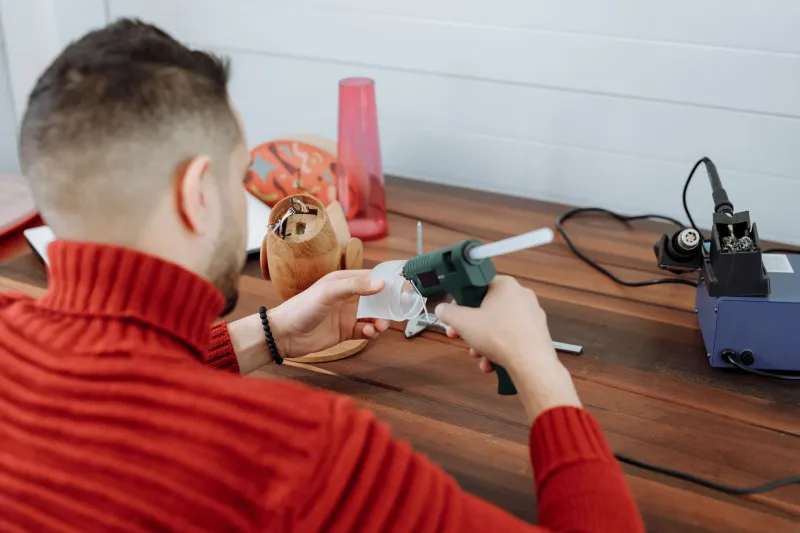
At 9:12 on a grey Saturday morning in Birmingham, a cape is having a crisis. Its owner is due at the convention doors in forty-eight minutes, the clasp has pinged off into a carpet tile, and a volunteer is already on their knees with a torch. The folding table above them carries a hand-written sign — 'Cosplay First Aid. Free. Ask nicely.' — and a plastic tub of hot-glue sticks that has seen things.
These pop-up repair tables are a familiar sight at UK conventions, from the ExCeL to the NEC, and increasingly at smaller community workshops in church halls, craft rooms and community centres. Some are official, hosted by convention accessibility or community teams. Many more are fan-run, assembled by people who simply know that a costume can fail at the worst possible moment and that a stranger with a needle might save the day.
The label 'repair café' is borrowed from the wider mending movement, the one that fixes toasters and lamps in village halls. Cosplay has added sequins, foam armour and a certain amount of panic. But the principle is the same: bring a broken thing, sit down with someone who knows a bit more, and leave with it working again — or at least holding together until the group photo.
The queue is a triage ward
A cosplay repair queue does not move like a normal queue. It moves like a triage ward. Someone with a split seam and an hour to spare will wave forward the person whose foam pauldron has snapped clean in half and whose photo shoot is in ten minutes. A wig that has lost half its pins outranks a loose button. A full armour rebuild does not outrank anything, because a repair table is not a commission service.
The etiquette is rarely written down, but regulars know it. State the problem. Show the damage. Accept the diagnosis. Do not grab the glue gun out of someone's hand. Do not ask for a full remake five minutes before doors. Be honest about your deadline, because the volunteer is already calculating drying times in their head. And say thank you — properly, not just with a nod.
The best tables are not tidy. They carry hot glue, E6000, gaffer tape, safety pins, spare elastic, curved needles, wig clips, wet wipes, plasters and a roll of bin bags for the bits that cannot be saved. There is usually a sewing machine somebody's aunt donated, and always one volunteer who can reattach a buckle with the calm of a bomb-disposal expert.
A generosity economy with receipts
What makes the repair table work is not just skill. It is a generosity economy. Hot glue is borrowed. Clamps are lent. A stranger's spare metre of elastic becomes your shoulder strap. Nobody is running a card machine. There might be a donation tin for restocking supplies or for a local charity, but the real currency is 'I'll be at the next one' — the promise that you will bring spare snaps to the next convention, or sit on the table yourself for an hour.
That economy has its own etiquette. You do not take without offering. You do not empty a volunteer's personal kit and disappear. You ask before using someone's good scissors. You return the clamp you borrowed, even if the person who lent it has already gone to a panel. And if you can, you leave something behind: a handful of safety pins, a roll of tape, a note that says 'for the next emergency'.
British reserve does not survive long at a repair table. People who would never talk to a stranger on a train will happily explain the structural weaknesses of EVA foam to a queue of attentive listeners. You can tell a lot about a fandom by what breaks. Armour cracks at the shin. Princess skirts lose their hems. Anime wigs shed pins like a cat in summer. Steampunk goggles give up at the hinge. The table has seen every genre, and it treats them all the same.
Why mending became the ritual
Cosplay has always been a making culture. Buying a costume is only half the job; fitting it to a real body, in a real hall, with real stairs and real crowds, is the rest. The repair table is where that work becomes visible. It is a backstage space in public, a rare chance to be seen mid-disaster rather than only in the finished photo.
That is why it feels like a ritual rather than a service. The table offers permission to admit that something has gone wrong. In a fandom that often worships the polished final shot, the mending table worships the almost. It says: the costume is not ruined, it is in progress. The person wearing it is not failing, they are learning. And the fix does not have to be invisible. A bright stitch, a mismatched buckle, a patch of fresh foam — these are proof of a day survived.
There is also the quiet pleasure of watching someone learn. A volunteer shows you how to heat-seal foam so it does not tear again. You show the next person how to thread a needle with a wig pin. Skills move sideways through the queue. By the time the doors open, the table has produced a few dozen rescues and a handful of new menders.
If you go, bring patience
A repair table is not a magic wand. Bring the broken piece, bring any spare parts you have, and bring a willingness to learn. Do not bring a full commission and expect a rebuild. Do bring a question: 'Can this be saved?' is a good start. 'What would you do?' is even better.
And if you are the one with the glue gun, remember the table's real rule: the fix is rarely just the fix. It is the conversation, the borrowed tool, the stranger holding your cape while you explain where it hurts. The hot glue cools. The lesson stays. The most devoted costume is often the one that has been repaired in public.