The Pavement Setlist: How Britain’s Busker Regulars Learn a City by Its Chalkboards
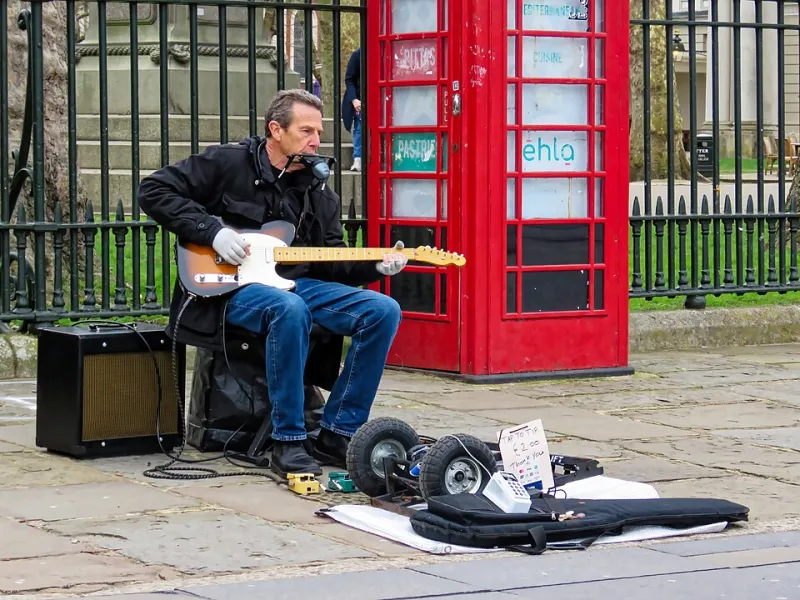
Photo: Acabashi, CC BY-SA 4.0, via Wikimedia Commons
On a damp Tuesday afternoon in Leeds, a handful of people are standing outside a phone shop with the patient air of a soundcheck. They are not waiting for a delivery. They are waiting for a busker with a loop pedal to finish untangling his cables. One of them has a thermos. Another has a folded fiver ready. When the first chord lands, nobody claps too early. That would be rude. This is a pavement gig, and the regulars know the rules.
Street performance has always relied on passing trade: the shoppers, the tourists, the people who stop for one song and drift on. But there is another audience in British city centres, smaller and quieter and far more devoted. These are the busker regulars — fans who learn a performer’s pitch rotation, read their chalkboard signs like a listings magazine, and plan a Saturday around a good spot by the statues. They are not official. There is no membership card. But once you notice them, you see them everywhere: the same faces at the edge of the chalk circle, nodding along to a set they have heard three times this month.
The chalkboard is the timetable
For a busker, the chalkboard is part sign, part shop window, part apology. It might say 'Back at 2', or 'Fiddle set at 1', or 'Requests £2'. It might just say 'Thanks for listening' with a drawn-on smiley. Regulars learn to read the small print. A board propped at an angle can mean the performer is on a break. A board with a set time on it is a promise. A board that has been wiped clean and rewritten three times in an hour is usually a sign that the council licensing officer has been round.
This is not quite a schedule. It is closer to a rumour with chalk on it. But for the people who follow a favourite busker, it is enough. They know that the good guitarist tends to set up near the market on Saturdays and the quieter cellist prefers the museum steps on weekdays. They know that rain pushes everyone under the same covered arcade, which means a better chance of an unplanned double bill. They know the difference between a pitch that looks busy and a pitch that actually sounds good. That knowledge is earned by turning up, week after week, and paying attention.
Learning the pitch rotation
Every city centre has its own geography of sound. In Covent Garden, the pitches are licensed and the competition is fierce. In Birmingham, the same stretch of pavement can host a cellist at noon and a comedy magician at three. In Edinburgh, August turns the whole city into a stage and the regulars have to share their favourites with thousands of visitors. But wherever you are, there is a rotation. Buskers move between pitches. Councils have rules. Weather has opinions. The regulars learn the pattern the way other fans learn a tour itinerary.
'She’s at the Corn Exchange until four, then she usually tries the bridge,' one regular tells me outside a bakery in Bristol. She is not a stalker. She is a fan with a mental map. Her phone has a note titled 'good spots, bad weather' and a camera roll full of chalkboards. She has followed the same fiddler for two years. She has never introduced herself. She once bought a CD and a tote bag. That, she says, is the relationship.
This is fandom at ground level. It is not about merch drops or arena presales. It is about knowing that a performer plays a particular corner because the acoustics are kind, and that they will almost always finish with the same song because it makes people stop. It is about being the person who notices when they change the setlist. It is about turning a city you thought you knew into a venue with rooms.
The etiquette of the hat
Tipping is where the unspoken rules get really specific. Buskers do not pass a hat in the old music-hall sense. They put out a case, a bucket, a bag, a contactless reader. The regulars call it 'the hat' anyway. They know that a note is better than a handful of coppers, not because buskers are snobs but because coppers weigh down the case and make it harder to pack up. They know that you do not film an entire set and walk away without contributing. They know that you do not stand inside the chalk circle, block the sightline, or ask for Wonderwall while someone is mid-loop.
The rule that regulars repeat most often is simple: tip at the end, not during the tricky bit. A fiver dropped into a case mid-song is a lovely gesture and a terrible distraction. Better to wait until the applause. Better still to buy the CD, the badge, the handwritten lyric sheet. The performance is free, but the relationship is not. The regulars understand that better than anyone.
A network of whispers and WhatsApp
There is no official club for busker regulars. But there are group chats. There are Facebook pages. There are quiet conversations at the edge of a crowd that turn into route tips: 'He’s moved to the market because of the rain.' 'She’s doing a longer set on Friday.' 'The comedy juggler is back, if that’s your thing.' The networks are loose and local, held together by people who happen to be free on a Saturday and know a good thing when they hear it.
This is not organised fandom in the way that, say, a theatre understudy campaign or a gig queue crew is organised. It is more like a neighbourhood watch for sound. The regulars look out for each other. They save spots. They tell the performer when a string has gone or a cable is fraying. They clap a little harder when the crowd is thin. They are not trying to make the busker famous. They are trying to make the afternoon good.
Why pavement gigs become rituals
A busker’s set is ephemeral. You cannot stream it later. You cannot buy a ticket for next Thursday. You have to be there, in the cold, with the pigeons and the shopping bags, and that is exactly what makes it feel like a ritual. The regulars are not chasing nostalgia. They are chasing the small thrill of a performance that exists only once, on a pavement, for whoever happens to be standing there.
The chalkboard will be wiped clean by closing time. The case will be zipped shut. The loop pedal will go back in the rucksack. But the regulars will remember where they stood, what was played, and whether the hat was good. They will come back next week. They will read the board. They will wait for the first chord. And when it lands, they will know exactly when to clap.